

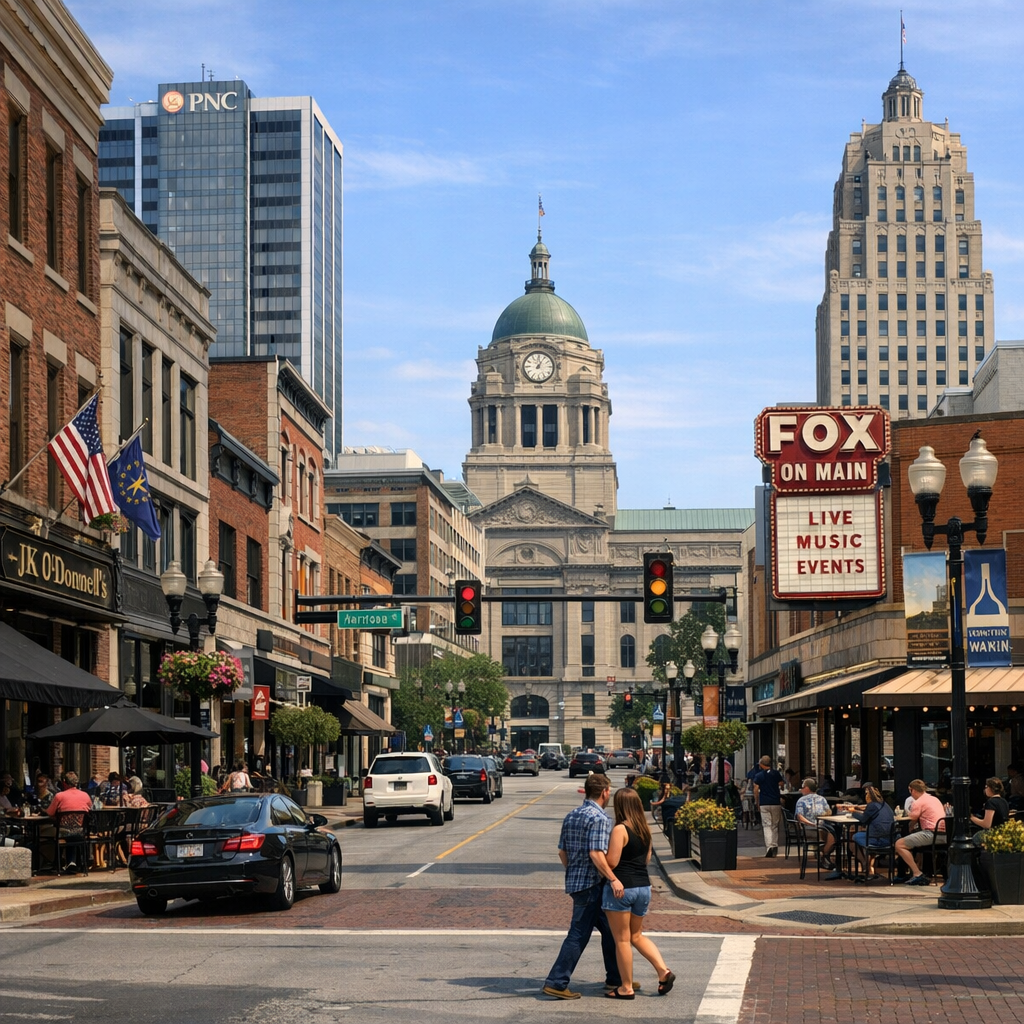
Fort Wayne is quietly entering a new chapter of economic growth marked by renewed investment, evolving industry trends, and a sharper focus on inclusivity. Recent developments show strength in construction, manufacturing, real estate, and entrepreneurship—while job growth fluctuates month to month. Here’s what local businesses and workers should know.
Shifts in job numbers and what they signal
Data from the U.S. Bureau of Labor Statistics shows that nonfarm employment in the Fort Wayne-Allen County area dipped by about 600 jobs in June, following modest gains earlier in the year. Even so, the overall trend since January points to a labor force of roughly 240,000, with an unemployment rate trending between 3% and 4%. These swings, though notable, don’t point to a crisis—they echo the kinds of adjustments a growing economy often experiences. (nonfarm employment data, unemployment rate, and labor force estimates.)
Meanwhile, employment growth over the past few years has been steady. In 2025, the region added a few dozen jobs on average each month. In 2026, despite some setbacks, the average monthly gain rose, suggesting accelerating momentum behind the job market. (comparison of yearly averages.)
Infrastructure, real estate, and business districts fueling opportunity
Fort Wayne isn’t just growing—it’s planning for the future. The Allen County Together (ACT) plan is driving the creation of high-quality commercial, industrial, and mixed-use spaces with the goal of bringing in new investment and jobs. Among ACT’s targets: attracting $1 billion in private investment along the downtown riverfront and adding 2,500 new higher-wage jobs by 2031. (ACT’s goals for commercial development and job creation.)
Add to that the expansion of Fort Wayne’s Downtown Improvement District from about 99 to 141 blocks. This move extends services like safety, snow removal, marketing, and public space upkeep into areas like the Broadway Arts District and Wells Street Corridor. Businesses in those newly included blocks are already reporting higher visibility and increased foot traffic. (benefits to small business in expanded DID.)
Entrepreneurship, support networks, and inclusion
Behind the scenes, efforts to build a more robust ecosystem for entrepreneurs are gaining traction. Organizations like Start Fort Wayne, SEED Fort Wayne, and the Northeast Indiana Innovation Center are engaged in strategies to offer greater access to capital, support services, and real estate for startups and small business owners. (ecosystem strategy and support networks.)
Local business owners emphasize the importance of inclusivity—particularly for women, people of color, and early-stage entrepreneurs. Barriers remain: uncertainty about where to find resources, limited representation in existing circuits of support, and a need for clearer pathways during the startup phase. (feedback from small business surveys and case studies.)
What this means for businesses and job seekers
- Businesses eyeing expansion or relocation should pay attention to how ACT and DID frameworks might offer infrastructure incentives or zoning flexibility.
- Aspiring entrepreneurs may benefit from leaning into local support groups early—grants, coaching, coworking spaces, and mentorship have real impact.
- Workers should keep upskilling in sectors showing growth—manufacturing, tech, logistics, and real estate—to seize emerging opportunities.
Overall, Fort Wayne’s economy is showing signs of both resilience and transformation. Job numbers may swing, but long-term plans point toward broader inclusion, stronger infrastructure, and opportunity for both enterprise and workforce. The pulse is steady—and getting stronger.